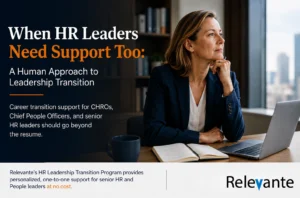
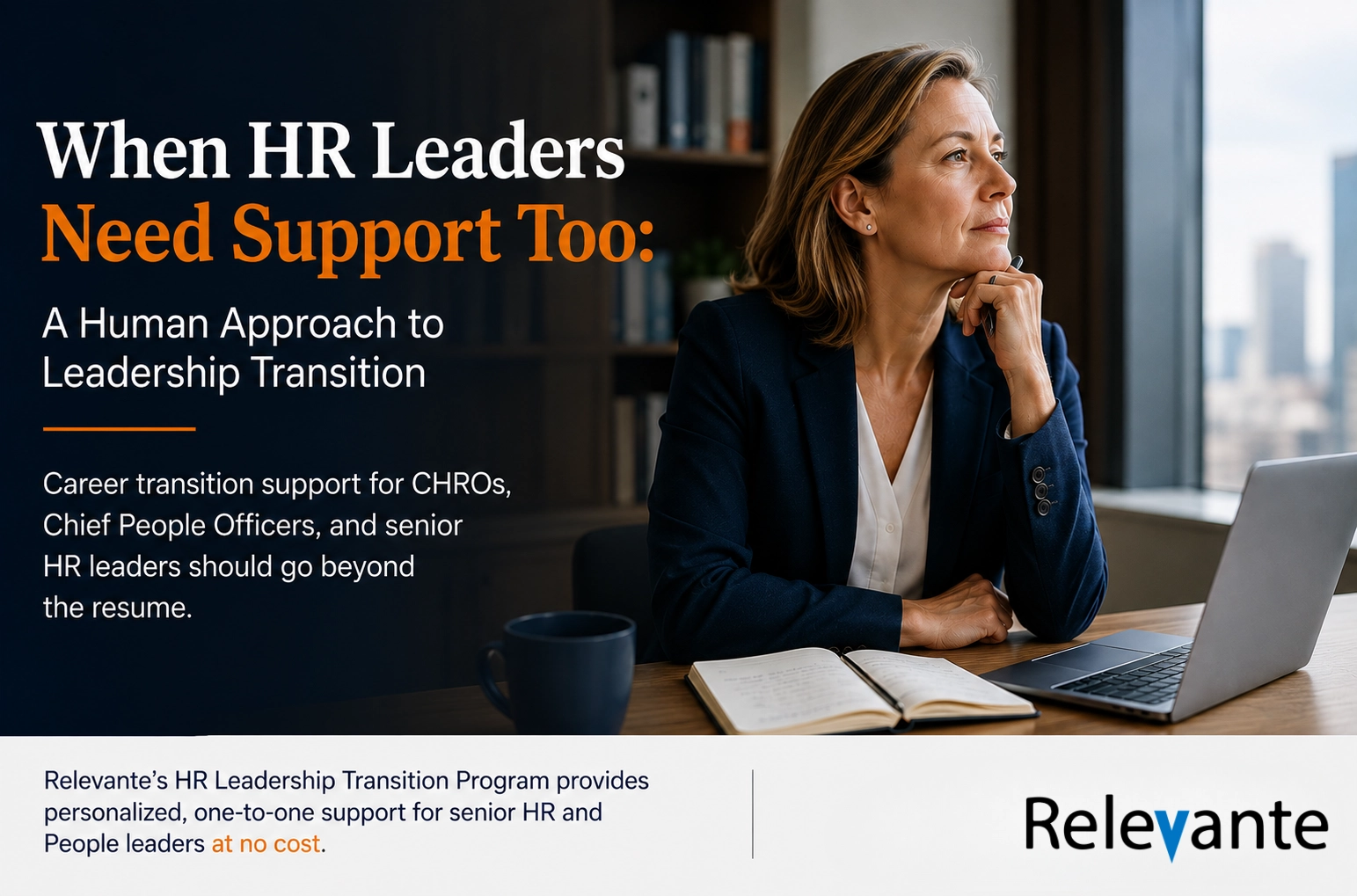
Career transition support for CHROs, Chief People Officers, and senior HR leaders should go beyond the resume.
HR leaders spend their careers helping other people navigate change.
They guide employees through restructuring, coach executives through difficult decisions, build leadership teams, manage organizational transformation, and help people think about what comes next in their careers. They are often the people employees and executives turn to when the future feels uncertain.
But when the HR leader becomes the person experiencing a career transition, the situation can feel very different.
A CHRO, Chief People Officer, VP of HR, HR Director, or senior People leader may suddenly find themselves asking questions they have helped others answer countless times: What should I do next? How should I position my experience? Who should I speak with? Should I pursue another corporate leadership role, explore consulting, consider an interim position, or look at a different industry?
These questions cannot always be answered by updating a resume and applying for jobs.
A senior HR career is built on leadership experience, business relationships, professional reputation, and years of accumulated knowledge. A meaningful transition strategy needs to account for all of those things.
That is why Relevante created its HR Leadership Transition Program, a pro bono career transition program designed specifically to support senior HR leaders as they navigate their next chapter.
Why HR Leadership Transitions Are Different
A career transition at the executive level is not simply a more senior version of a traditional job search.
For senior HR professionals, the next opportunity is often influenced by leadership reputation, executive relationships, industry knowledge, and the ability to demonstrate measurable business impact.
Consider the range of experience that a senior HR leader may bring to the table. Over the course of a career, they may have led organizational transformation, developed talent strategies, supported mergers and acquisitions, built succession plans, redesigned compensation programs, strengthened employee engagement, developed executive teams, or guided organizations through significant workforce changes.
The challenge is that years of experience can sometimes make it harder to communicate a focused professional identity.
A resume can show where someone worked and what positions they held. It does not automatically explain what kind of leader they are, what business problems they solve, or why a CEO or board should consider them for the next opportunity.
That is where thoughtful HR executive career transition support becomes valuable.
The goal is not simply to make an executive look better on paper. It is to help them understand their own leadership story and communicate it in a way that is relevant to the organizations and opportunities they want to pursue.
Your Career History Is More Than a List of Job Titles
Senior HR professionals often underestimate how much value is contained within their career history.
A leader who has spent years working with CEOs, boards, business-unit leaders, and employees has developed a perspective that goes far beyond traditional HR administration.
They understand how people decisions affect business performance. They have seen organizations grow, restructure, acquire other businesses, enter new markets, change leadership teams, and respond to periods of uncertainty.
That experience should become part of the career narrative.
During a transition, it can be useful to look at questions such as:
- What business challenges have you repeatedly been trusted to solve? Perhaps your strongest experience is in transformation, workforce strategy, organizational design, talent development, culture, or executive leadership.
- What changed because of your leadership? The strongest executive stories connect HR initiatives to outcomes such as growth, organizational effectiveness, leadership capability, retention, productivity, cost management, or successful transformation.
- What environments bring out your strengths? Some leaders thrive in high-growth companies, while others are particularly effective during transformation, restructuring, integration, or periods of organizational complexity.
- What should your next role actually look like? The right move may be another CHRO position, a Chief People Officer role, a VP of HR opportunity, an advisory position, consulting, or an interim leadership assignment.
Answering these questions can create a much clearer foundation for an executive career transition.
Networking Matters More at the Executive Level
For senior HR leaders, professional networking is not simply about meeting more people.
It is about maintaining relationships that have been built over years and knowing when and how to activate them.
A former CEO may know of an organization preparing for a leadership change. A former colleague may have moved into a company that is expanding its executive team. An HR peer may know an executive recruiter working on a confidential search. A board connection may be able to provide an introduction that a traditional application never could.
Yet reaching out can feel uncomfortable.
Senior professionals may not want to announce publicly that they are searching for a role. They may be concerned about confidentiality, particularly if they are still employed. Others may simply feel awkward contacting people after several years without speaking.
A good HR leadership transition strategy should take these realities into account.
Instead of approaching networking as asking everyone for a job, the focus can be on reconnecting with people, exchanging ideas, learning what is happening in the market, and having authentic conversations about where the leader’s experience may be relevant.
That creates a more natural path to opportunity.
The Executive Job Market Is Not Just About Job Boards
Senior HR positions are not always discovered through traditional job applications.
Some roles are publicly advertised, but executive opportunities can also develop through search firms, referrals, professional networks, board relationships, CEO connections, industry communities, and conversations that begin months before a formal position is announced.
This makes it important for HR executives to think about their career transition as a broader market strategy.
That strategy can include:
- Building relationships with executive recruiters: Connecting with search professionals who specialize in senior HR and People leadership roles can increase visibility for opportunities that may not be widely advertised.
- Developing a target-company strategy: Instead of applying to every available HR leadership position, executives can identify organizations where their experience, leadership style, industry background, and transformation experience are particularly relevant.
- Reactivating professional relationships: Former colleagues, business leaders, HR peers, mentors, and professional contacts can provide valuable introductions, market intelligence, and perspective.
- Strengthening executive positioning: Resume, LinkedIn, professional biography, and networking messages should communicate a consistent leadership story rather than presenting disconnected career information.
- Considering alternative leadership paths: Some executives may discover that consulting, fractional leadership, interim assignments, advisory roles, or board-related opportunities are relevant to their next chapter.
The right combination depends on the individual’s career history and goals. There is no single formula that works for every HR executive.
Why One-to-One Support Matters
Career transition can become frustrating when advice feels generic.
A senior HR leader does not necessarily need another checklist telling them to update their resume, optimize LinkedIn, and network more.
They need someone who understands their particular career.
Someone who can look at their experience and help identify what makes them different.
Someone who can challenge them when their career story is too broad.
Someone who can help them decide which opportunities are worth pursuing and which are simply distractions.
That is one of the reasons Relevante’s HR Leadership Transition Program is built around one-to-one coaching.
Qualifying participants are connected with a dedicated Certified Career Coach whose support is aligned with the individual’s function, industry, and location. This creates continuity throughout the transition instead of requiring the executive to repeatedly explain their background to different people.
The coach can become a consistent sounding board as the participant works through positioning, networking, interviews, offers, and the eventual transition into a new role.
What Relevante’s HR Leadership Transition Program Can Help With
A successful executive transition involves much more than getting a resume ready.
Relevante’s program addresses several stages of the career transition process, helping participants approach the search with greater clarity and preparation.
- Executive resume and personal brand development: The focus is on presenting leadership experience in terms of impact, scope, accomplishments, and business value. Instead of simply listing responsibilities, the executive can build a clearer story around the problems they have solved and the organizations they have helped lead.
- LinkedIn positioning: For senior HR leaders, LinkedIn can be an important part of professional visibility. A strong profile should communicate leadership expertise and career direction clearly to recruiters, executives, professional contacts, and potential employers.
- Interview preparation and practice: Senior HR leaders are often experienced interviewers, but being the candidate creates a different dynamic. Preparation can help executives communicate their leadership philosophy, business impact, difficult decisions, transformation experience, and career goals with confidence.
- Strategic networking: Networking support can help participants identify the relationships that matter most, determine how to reconnect with those contacts, and develop conversations that feel authentic rather than transactional.
- Offer and compensation evaluation: Receiving an executive offer is an important milestone, but accepting the first opportunity is not always the right decision. Leaders may need to consider compensation, scope, reporting relationships, incentives, flexibility, organizational culture, and long-term career value.
- Support during the first 90 days: A career transition does not necessarily end when a new role begins. The first few months can determine how effectively a leader builds relationships, establishes credibility, understands organizational dynamics, and creates early wins.
By bringing these pieces together, the program treats career transition as a process rather than a collection of disconnected tasks.
Sometimes the Right Next Move Is Not Obvious
One of the benefits of taking a step back during a career transition is having the opportunity to reconsider what comes next.
A senior HR leader may initially assume that the only logical move is another CHRO or VP of HR position.
But after examining their experience, they may discover other possibilities.
Someone with extensive transformation experience may be well suited to an organization undergoing significant change. A leader with strong M&A experience may be valuable to a company actively acquiring businesses. Someone with a deep talent background may find opportunities in leadership development or organizational consulting.
Others may decide that they want to move into advisory work, fractional leadership, interim executive roles, or a different industry altogether.
A good career transition process should not force an executive toward one predetermined outcome.
It should create enough space to understand the possibilities and make an informed decision.
The Human Side of an Executive Career Transition
There is an emotional dimension to executive career transition that is easy to overlook.
Senior leaders are accustomed to being the people with answers.
They advise others. They make decisions. They manage uncertainty. They support employees through difficult moments.
When the uncertainty becomes personal, it can be uncomfortable to admit that they need support themselves.
A leader may wonder whether their experience is still relevant, whether their age or career history will affect their options, whether they should change industries, or whether they have been too closely associated with their previous organization.
These concerns are not solved by a resume template.
They require honest conversations.
Sometimes a career coach’s most valuable contribution is helping an executive recognize the strengths that they have stopped seeing because those strengths have become normal to them.
A career built over decades contains significant value. The challenge is learning how to see it clearly and communicate it effectively.
Why Employers Should Support HR Leaders During Transition
Organizations also have a responsibility to think about how they handle leadership transitions.
The way an organization supports departing leaders can influence the experience of the person leaving as well as the people who remain.
For HR leaders, this can be particularly meaningful.
These are the professionals who have spent their careers advocating for employee experience, leadership development, respectful communication, and thoughtful workforce practices.
Providing career transition support is one way organizations can demonstrate that those principles continue to matter when a leadership relationship comes to an end.
It can also help departing executives approach their next chapter with greater confidence and dignity.
Relevante’s HR Leadership Transition Program: Giving Back to the HR Community
Relevante created its HR Leadership Transition Program as a way to give back to the HR community.
The program is offered on a pro bono basis to qualifying senior HR professionals, providing access to individualized career transition support without the financial barrier that can come with traditional executive coaching or outplacement services.
The philosophy behind the program is straightforward.
HR leaders spend their careers helping other people navigate professional change. When they experience that change themselves, they should not have to figure everything out alone.
The program provides a dedicated career coach and practical support across the transition, from professional positioning and networking through interviews, offers, and the early stages of a new role.
It is not about treating an experienced HR leader as someone who needs to start over.
It is about helping them recognize what they have already built and determine how that experience can create value in their next chapter.
Your Career Does Not End When Your Role Does
A leadership position can come to an end without the value of the leader disappearing. The experience they have gained, the relationships they have built, the lessons they have learned, and the ability to lead through difficult situations all remain. The people they have developed, the organizations they have helped transform, and the business challenges they have solved become part of the professional value they carry into whatever comes next.
A career transition can be an opportunity to bring those experiences together, reflect on what has been accomplished, and determine where that experience can create the most value in the future. For senior HR professionals, that process deserves to be personal and thoughtful. It should recognize that the person navigating the transition is far more than the title they held on their previous business card.
Relevante’s HR Leadership Transition Program was created to provide this kind of personalized career transition support to qualifying HR leaders at no cost. The program is built around the belief that HR professionals who have spent their careers helping organizations and people navigate change should have meaningful support when they find themselves navigating change in their own careers.
When the transition becomes theirs, they deserve someone in their corner too.
If you know a CHRO, Chief People Officer, VP of HR, HR Director, Head of People, or another senior HR leader who is navigating a career transition, sharing the HR Leadership Transition Program could be a meaningful way to help them find the support they need for what comes next.