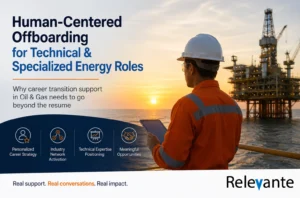
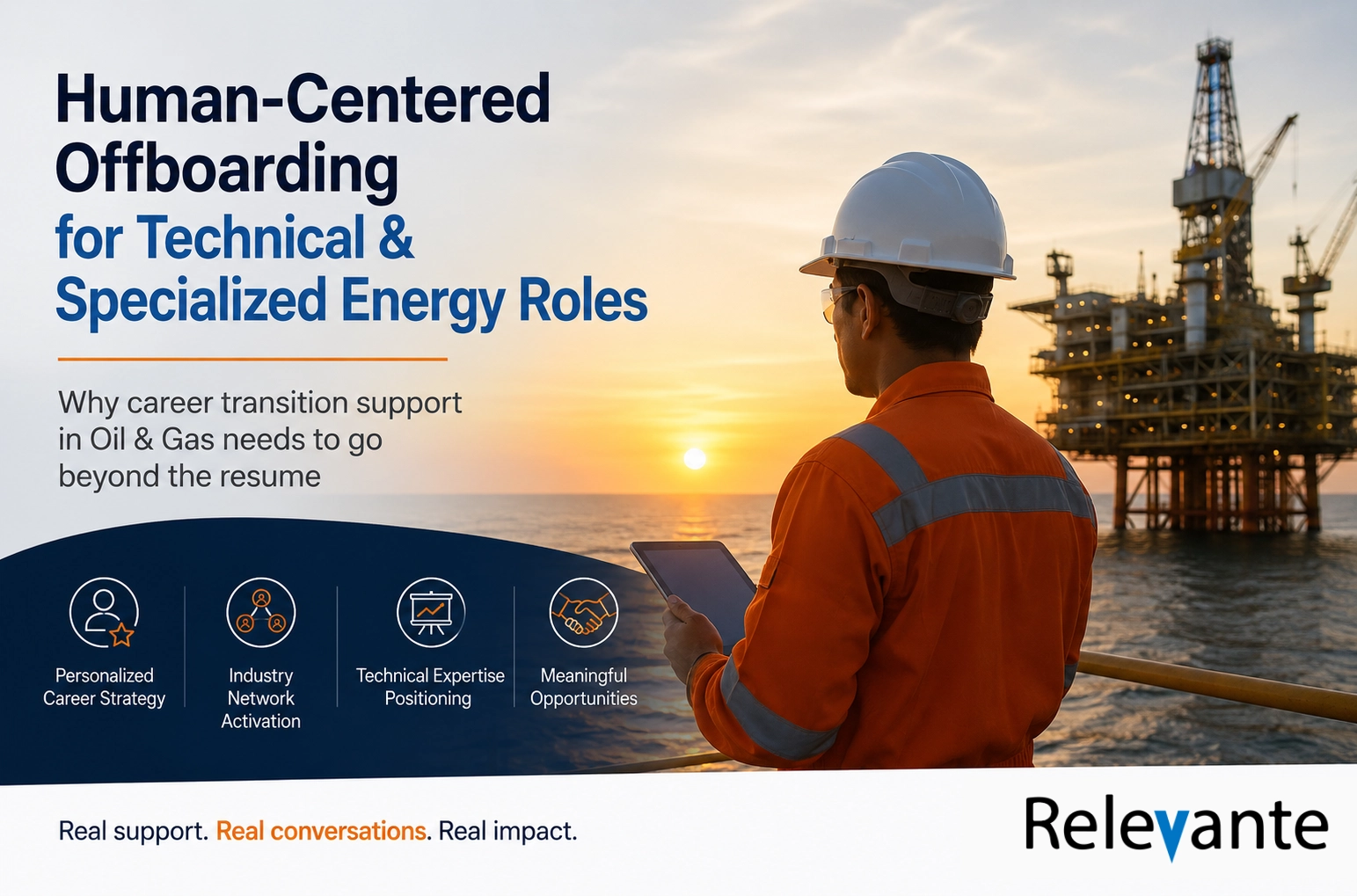
Why career transition support in Oil & Gas needs to go beyond the resume
When an Oil & Gas professional leaves a company, the transition rarely begins and ends with updating a resume.
For someone who has spent 10, 15, or even 20 years building expertise in reservoir engineering, geophysics, drilling, production, HSE, project management, or another specialized discipline, their career has been built around much more than a job title.
It has been built around relationships.
Former colleagues. Technical peers. Clients. Vendors. Recruiters. Industry associations. Conference contacts. Professional mentors. People they worked with on projects years ago.
In Energy, these relationships can be particularly important because many opportunities are shaped by industry reputation, technical credibility, and who knows your work.
That is why effective outplacement for specialized Energy professionals cannot be reduced to resume templates, job boards, and application tracking.
The real question is not just, Where can this person apply?
It is: Where does their expertise have value, who needs that expertise, and how can we help them get into the right conversations?
Technical Expertise Needs a Targeted Career Strategy
One of the biggest challenges specialized professionals face during a career transition is explaining the value of highly technical experience outside the context of their previous employer.
A reservoir engineer may have spent years working on reservoir characterization, simulation, production optimization, field development planning, reserves evaluation, or asset economics.
A geophysicist may have deep experience in seismic interpretation, exploration, subsurface evaluation, geoscience data, or basin analysis.
A drilling professional may have managed complex drilling programs, well planning, operational risk, contractors, or field execution.
An HSE leader may bring years of experience in safety management systems, regulatory compliance, operational risk, incident prevention, emergency response, and safety culture.
A production engineer may understand artificial lift, production optimization, well performance, troubleshooting, and field operations at a level that cannot be captured by a list of job responsibilities.
The challenge is translating that expertise into a story that makes sense to the next employer.
This is where specialized outplacement can make a meaningful difference.
At Relevante, career transition support can focus on helping professionals identify the skills, accomplishments, relationships, and industry knowledge that make them valuable in the market today.
That means looking beyond: What was your previous job?
And asking: What problems can you solve, what business impact have you created, and where can that experience be valuable next?
In Energy, Your Network Is Part of Your Career Infrastructure
For many Energy professionals, networking is not simply a career-development activity; it is part of how the industry operates.
Houston is a good example.
The region brings together operators, oilfield service companies, technology providers, engineering and consulting firms, energy investors, professional associations, recruiters, and thousands of specialized professionals.
Organizations such as the Society of Petroleum Engineers, AAPG, Energy Workforce & Technology Council, and other industry groups provide opportunities to learn, exchange ideas, meet peers, and build professional relationships.
SPE’s Gulf Coast Section, for example, has supported career-focused networking through its Career Advancement Network and dedicated hiring events. Its 2026 event at OTC brought together 174 job-seeking participants with employers and recruiters.
Energy Workforce & Technology Council also maintains an active calendar of Houston and Midland events covering networking, leadership, training, conferences, and industry education.
For geoscience professionals, AAPG’s professional-affairs programs include networking, professional development, career planning, and career-focused activities.
For someone navigating a career transition, these environments can become important parts of a job-search strategy.
But simply telling someone to attend an industry event is not enough.
They need to know which events matter, who they should meet, how to introduce themselves, what conversations to have, and how to follow up afterward.
That is where human support is important.
Relevante’s Approach: Turn Experience into a Career Transition Strategy
At Relevante, we believe specialized professionals deserve support that reflects the careers they have actually built.
That means starting with the individual rather than starting with a generic outplacement checklist.
Our Energy outplacement services are designed around the realities of Energy careers and the different challenges professionals can face when navigating a transition.
A career transition strategy for an Energy professional can involve several connected pieces.
1. Understanding the Professional Story
- Before deciding where someone should apply, it is important to understand what they have actually done.
- What types of assets have they worked on?
- What technical problems have they solved?
- What projects have they led?
- What technologies or methodologies do they understand?
- Have they worked with operators, service companies, consulting firms, or technology providers?
- Have they managed teams, budgets, vendors, clients, or major operational risks?
- Relevante can help professionals step back from their previous job description and identify the experience that has genuine market value.
2. Mapping the Professional Network
A strong network often contains more potential than a professional realizes.
Relevante can help individuals identify and organize relevant relationships, including:
- Former colleagues and managers
- Technical peers
- Clients and customers
- Vendors and service providers
- Recruiters and executive search professionals
- Professional association contacts
- Conference and event connections
- Alumni networks
- Former project partners
- Industry mentors and peers
The objective isn’t to contact everyone.
It is to identify the relationships most likely to lead to useful conversations, introductions, market information, or opportunities.
3. Finding the Right Industry Communities
- Different specialties have different professional ecosystems.
- A geophysicist may benefit from one set of technical communities.
- A drilling engineer may have an entirely different network.
- An HSE leader may need to engage with safety, regulatory, operational, and leadership communities.
Relevante can help professionals identify relevant associations, conferences, technical forums, local events, and industry communities based on their discipline, seniority, geography, and career goals.
This makes networking more intentional.
Instead of: Attend more networking events.
The strategy becomes: Here are the communities where people relevant to your next career move are already having conversations.
4. Translating Technical Experience into Business Value
Technical professionals sometimes undersell themselves because they describe their experience through responsibilities rather than outcomes.
Instead of simply saying:
- Managed reservoir simulation activities.
- The career story should help an employer understand the larger value.
- What decisions did the analysis support?
- What operational or financial impact did it have?
- What challenges did the professional solve?
- What changed because of their work?
Relevante’s support can help professionals communicate technical expertise in a way that is understandable and compelling to recruiters, hiring managers, executives, and industry contacts.
The goal isn’t to remove the technical depth.
It is to connect that technical depth to business impact.
5. Building Targeted Outreach
A specialized Energy professional may not benefit from sending hundreds of generic applications.
A more effective strategy can involve identifying specific companies, teams, decisionmakers, recruiters, and industry contacts who are relevant to the individual’s background.
Relevante can support professionals in developing personalized outreach approaches for different situations.
A former colleague may require a different message than a recruiter.
A technical leader at a target company may require a different conversation than an industry contact met at a conference.
The objective is to make outreach feel like a professional conversation, not a mass job application.
6. Preparing for Industry-Specific Conversations
Getting an introduction is only the beginning.
Specialized professionals also need to be prepared for what happens next.
That could mean discussing:
- Technical projects
- Operational challenges
- Leadership experience
- Technology adoption
- Cost and efficiency improvements
- Safety performance
- Asset performance
- Cross-functional collaboration
- Regulatory requirements
- Client and stakeholder management
- Commercial impact
Relevante can help professionals prepare for these conversations so they can explain their experience clearly without either oversimplifying their expertise or overwhelming the listener with technical detail.
Career Transitions Don’t Always Mean Leaving Energy
Another important part of specialized outplacement is helping professionals recognize that their next opportunity may not look exactly like their previous one.
An experienced Oil & Gas professional may move:
- From an operator to an oilfield service company.
- From a technical role to consulting.
- From field operations to technology or digital solutions.
- From engineering to project or program leadership.
- From traditional Oil & Gas into another part of the broader Energy ecosystem.
The transferable value of technical experience can extend into engineering services, energy technology, industrial organizations, consulting, chemicals, infrastructure, and other adjacent sectors.
Relevante can help professionals evaluate these possibilities without losing sight of what makes their experience distinctive.
The goal is not to push someone into an entirely different career.
It is to help them see the full range of realistic options available to them.
The Human Side of Specialized Career Transitions
There is also a part of career transition that cannot be captured in a resume.
For someone who has spent decades building a professional identity around a technical discipline, losing a role can feel like more than losing a paycheck.
It can disrupt their sense of professional direction.
They may be asking:
- Is my experience still relevant?
- Do companies still value what I know?
- Should I stay in Oil & Gas?
- Should I consider another part of Energy?
- How do I explain a 20-year career to a new employer?
- Where do I even start?
These questions require more than a template.
They require someone to listen, understand the individual’s background, challenge assumptions when necessary, and help turn uncertainty into a practical plan.
That is the human side of outplacement.
At Relevante, the objective is not simply to move someone through a standardized process.
It is to help them understand where they stand, where they want to go, and what needs to happen between those two points.
For Energy Employers, the Responsibility Begins Before the Last Day
For organizations managing restructuring, workforce reductions, acquisitions, divestitures, asset changes, or shifts in business priorities, the way employees leave matters.
This is especially true when the workforce includes highly specialized professionals whose expertise has taken years to develop.
Providing meaningful outplacement support can help organizations demonstrate that they recognize the contribution of departing employees and are willing to support them through the next stage of their careers.
For Energy employers, that support should reflect the realities of the industry.
A generic resume workshop may have a place in a broader program.
But a reservoir engineer, geophysicist, HSE leader, or drilling specialist may need something much more targeted.
They may need help identifying the right industry communities.
They may need to reconnect with former colleagues.
They may need to understand adjacent career paths.
They may need to reposition years of technical experience for a different organization.
And they may simply need someone who understands that a career transition is not only a professional challenge. It is a personal one.
Outplacement Should Activate Experience, Not Replace It
The strongest career transition programs don’t ask professionals to start over.
- They help them recognize what they already have.
- Their technical knowledge.
- Their industry experience.
- Their professional relationships.
- Their reputation.
- Their leadership skills.
- Their understanding of the Energy market.
- Their ability to solve problems that took years to learn.
At Relevante, we believe human-centered outplacement should bring these pieces together into a practical career transition strategy.
For specialized Energy professionals, that means going beyond the resume and helping turn years of experience into clear positioning, meaningful conversations, stronger professional connections, and realistic next opportunities.
For employers looking for a more targeted approach to workforce transition, our Texas outplacement services provide additional support for organizations and professionals navigating the Texas employment market, including the highly connected Houston Energy ecosystem.
Because the next opportunity may not come from another job application.
It may start with someone who already knows your work.
And sometimes, the most valuable thing an outplacement partner can do is help you figure out who that person is, what to say, and what comes next.